EngSplainin’
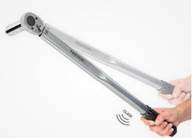
a pivot click torque wrench.
So
you think you can reef on a one of these anywhere you like, good luck with
that!
Your
greasy mitt has to be on the handle IN THE RIGHT PLACE and here is why…
In
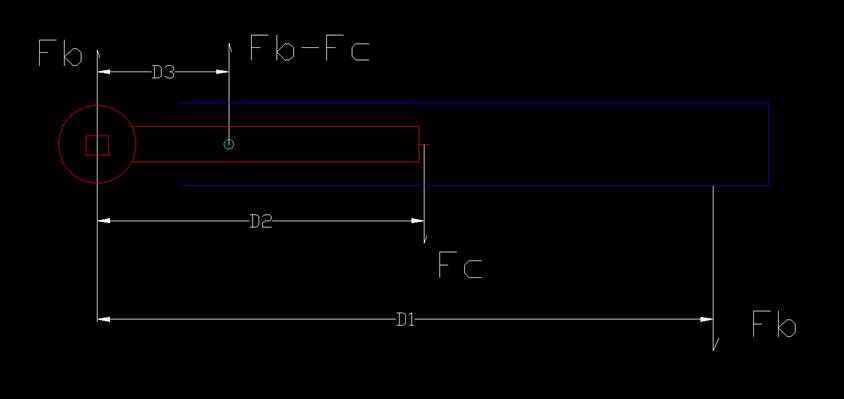
the depiction below:
·
Fb
= the Bogun force (your greasy mitt and Fosters powered muscle),
·
Fc
= the “click” force of your calibrated torque wrench (constant),
·
D1=
distance from bolt center to your mitt,
·
D2
= distance from pivot to clicker,
·
D3
= distance from pivot to bolt center,
·
Mega
= a hell of a lot,
·
SFA
= Sweet F All or bugger all.
Assumptions:
1. Fc is calibrated and is
CONSTANT. It cannot change and gives the
same force every time it is actuated within variation of the mechanism (SFA),
2. STP standard temperature and
pressure,
3. Standard gravity,
4. Standard laws of physics,
5. Above room temperature IQ, if you
can read this you pass,
6. ONLY D1 is changed in any testing as
an input.
Some
of the forces detailed are reaction some are action this is very simplified but
I hope will get the point across as to where this “magic” torque is coming
from. It is the reaction on the pin
equal to Fb - Fc
Now
for the splainin’:
Bolt
torque is (D1 x Fb) + ((Fb-Fc) x D3). If
your mitt is in the right place it works.
If
D1 gets VERY big, it affects the force needed and Fb becomes SFA to click the
torque wrench but the second part of the torque formula gets very small and the
((Fb-Fc) x D3) component of APPLIED TOTAL Torque is low so if you put a cheater
bar on the torque wrench you will UNDER torque the fastener.
Conversely
if you “choke up” and D1 gets small, Fb becomes a Megaforce,
you will be blowing chunks to get that wrench to click. ((Fb-Fc) x D3) becomes MUCH bigger and you
will OVER torque the fastener.
The
point that is missed is the fastener has TWO applied torques on these pin torch
wrenches and the D1 length will directly affect the amount of force, and
thereby magnitude of second torque that is applied to the fastener.
Please
apply safe torques to your member and appropriate harmonic frequencies to ming moles.
There
is even a Torque Wrench SIMULATOR.
Download
the Excel sheet, see the formulas, prove to yourself it is a problem to choke
up (over-torque) or cheater bar (under-torque).